


The devastating earthquake in 2015 had unequivocally cautioned us to do all we can towards achieving environmental equilibrium. Pathologically, we have already been nursing huge handicaps on the seismic count, but, the fact that we have not been alert and vigilant on human-initiated measures, calls for serious introspection and a committed following of practices that should largely help us tide over the ever-existing threat in the form of potential calamities. We are aware that we are an earthquake-prone nation for hundreds of years, and yet our sense of preparedness and adaptation of precautionary measures, unfortunately leaves us in a state of utter dismay. We need to be extra cautious with varied aspects that cause an impact on the environment. At the time of writing this note on the eve of the World Environment Day, today, several news/features appear in the media raising concern about the carbon emission issues that we are so much concerned about – but, corrective measures are unfortunately missing. These remind us, inter alia, so emphatically of the thousands of lives lost due to indoor air pollution and other catastrophes, but an all-pervasive apathy allows no action. We must act without any further loss of time if we have to contribute in saving the planet and in saving lives of our underprivileged milieu who fall victims to a menace that is absolutely avoidable. Hope we are listening! Against the aforesaid backdrop we analyze the status of diverse energy sources used in various sections.
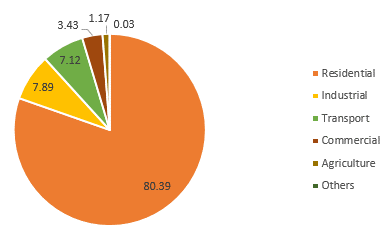
Since accurate, credible and updated data in the larger context of energy use, are not available across sources, we are delving largely on a sense gathered from varied data.
As we see in a preceding info-graphic, residential sector is the largest user followed by industry, transport and the rest. Since accurate, updated data is not available on the most widely used energy source, i.e., solid biomass (in the form of firewood primarily), we are discussing herein on the basis of rational comprehension gathered from variety of information. Data is generally available for the next most used sources of energy, through NOC for fossil fuel used (diesel, petrol, kerosene, LPG etc) and for electricity distributed from NEA – but the grey area remains that of solid biomass. Taking a sense from various sources, it is alarmingly understood that an astounding sum of about 17 million tons/annum only for cooking! (Source: https://energypedia.info/wiki/Nepal_Energy_Situation#Energy_Consumption ) was used long time ago (for which data is somehow available) wherein the situation has only worsened with increase in population and the pressure on the forests. Out of the 17 million tons of solid biomass used, about 10 million tons were not from sustainable supply and were understandably over-exploited – so to suggest that the trees were harvested in a premature state! A scenario of blatant deforestation!To vindicate the authenticity of these numbers (at least in approximation) the“Biomass Energy Support Program 2012” and “ESAP Report 2013” also suggests an average annual use of firewood as 2500-3500 kgs/household. The average size of a household reckoned is 5 persons/household and the number of households understood to be depending on firewood use is about 5 million today.
Can we imagine the opportunity cost of 10 million tons of over exploited felling of trees? The ecological disaster deforestation of this scale spells, needless to mention, is frightening!
The opportunity cost in value terms, very conservatively, could be reckoned as follows:
It means approximately 8.8 million cubic meters of Sal Wood primarily, i.e., about 300 million cft which sells at about Rs 4500/cft. Yet, let us reckon only a conventional,average cost of Rs 2500/cft considering there are few other tree species in some measure other than Sal Wood, as well.The value works out to Rs 750 billion rupees. It is mind-boggling for a country of a measly 25 billion US Dollars of GDP! Whereas we have computed only the over exploited portion of 10 million tons, the value of 7 million tons need to be reckoned at the firewood cost of the concerned undertakingin the country, such as TCN, say, @ Rs 15/kg, which works to Rs 105,000 million, or Rs 105 billion. Both put together, it is 855 billion rupees – 1/3rd of the country’s GDP!
Putting opportunity cost aside, even if we reckon the bare firewood cost @ Rs 15/kg, the value of 17 million tons is approximately Rs 255,000 million, i.e., Rs 255 billion!
This cost component assumes a substantial portion in a rural household’s budget and the environmental impediment this poses is very serious.
The policy makers, the multilateral and bilateral development organizations supporting these critical programs including those under the spirit of Sustainable Development Goals, may like to look at this with the seriousness it deserves.
The toll it takes on the health of the women cooking on firewood is too frightening. The hazards open air cooking on firewood poses, are extremely serious and have repercussions also on the health of the children borne to the women having to go through such a chore, day-in and day-out. As per WHO, “3.8 million people a year die prematurely from illness attributable to the household air pollution caused by the inefficient use of solid fuels and kerosene for cooking.”
“27% are due to pneumonia, 18% from stroke, 27% from ischemic heart disease, 20% from chronic obstructive pulmonary disease (COPD), 8% from lung cancer” (Source: https://www.who.int/news-room/fact-sheets/detail/household-air-pollution-and-health) We have here above discussed the toll deforestation beckons and shall briefly discuss the fossil fuel scenario. Our Fossil fuel consumption revolves around two areas primarily: Transport & Residential (for cooking). Addressing substitution of the source of energy in the transport domain will take time as this will entail either going electric largely once our hydroelectricity portfolio builds up, or large capacities of CNG are augmented, but it is absolutely within reach in the residential (cooking energy) arena if we exercise an earnest will. Addressing the sources in the residential (cooking energy) domain assumes more significance also because of the massive disaster the collective incidence of climatic peril deforestation and fossil fuel cause. Towards this end, we may review our carbon footprint due to massive deforestation on one hand and excessive use of fossil fuel on the other in the residential sector.
In the residential sector again, the cooking portfolio of energy used is much larger than the other – as that of electricity for lighting and appliance, which is within a band of 6 billion kilo watt hours/annum which in value terms is below 70 billion rupees/annum, as against the colossal numbers we have seen here above in servicing the need for energy in cooking the cost of which – both environmental as well as monetary - is many times more. We are therefore taking up the more weighted section as that of energy for cooking here below.
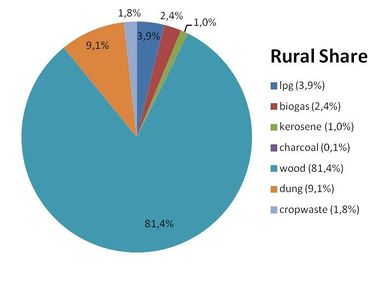
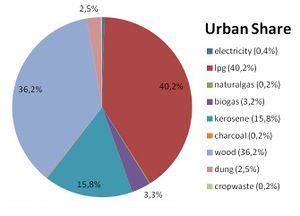
Let us first have a look at the various sources of energy used for cooking here.
Percentage of energy types used for cooking in urban and rural households
Following table suggests the break-up of various cooking solutions in use in 2015 and what is envisaged in the years ahead.
| Year | Traditional cook Stoves | In situ ICS | Factory-produced ICS | Biogas stoves | Kerosene stoves | Electric stoves | LPG stoves |
|---|---|---|---|---|---|---|---|
| 2015 | 3759938(60.83) | 434635(7.03) | 23060(0.37) | 349586(5.66) | 21137(0.34) | 15747(0.25) | 1577060(25.51) |
| 2023 | 2876912(41.02) | 1329558(18.96) | 101360(1.45) | 450289(6.42) | 3211(0.05) | 17854(0.25) | 2233806(31.85) |
| 2028 | 1711725(22.76) | 2674217(35.56) | 150860(2.01) | 527475(7.01) | 989(0.01) | 19388(0.26) | 2435415(32.39) |
| 2030 | 962795(12.36) | 3536652(45.39) | 170660(2.19) | 580000(7.44) | 617(0.01) | 20056(0.26) | 2520245(32.35) |
Note: Table shows numbers of households; figures in parentheses show the percentage of households in the total.
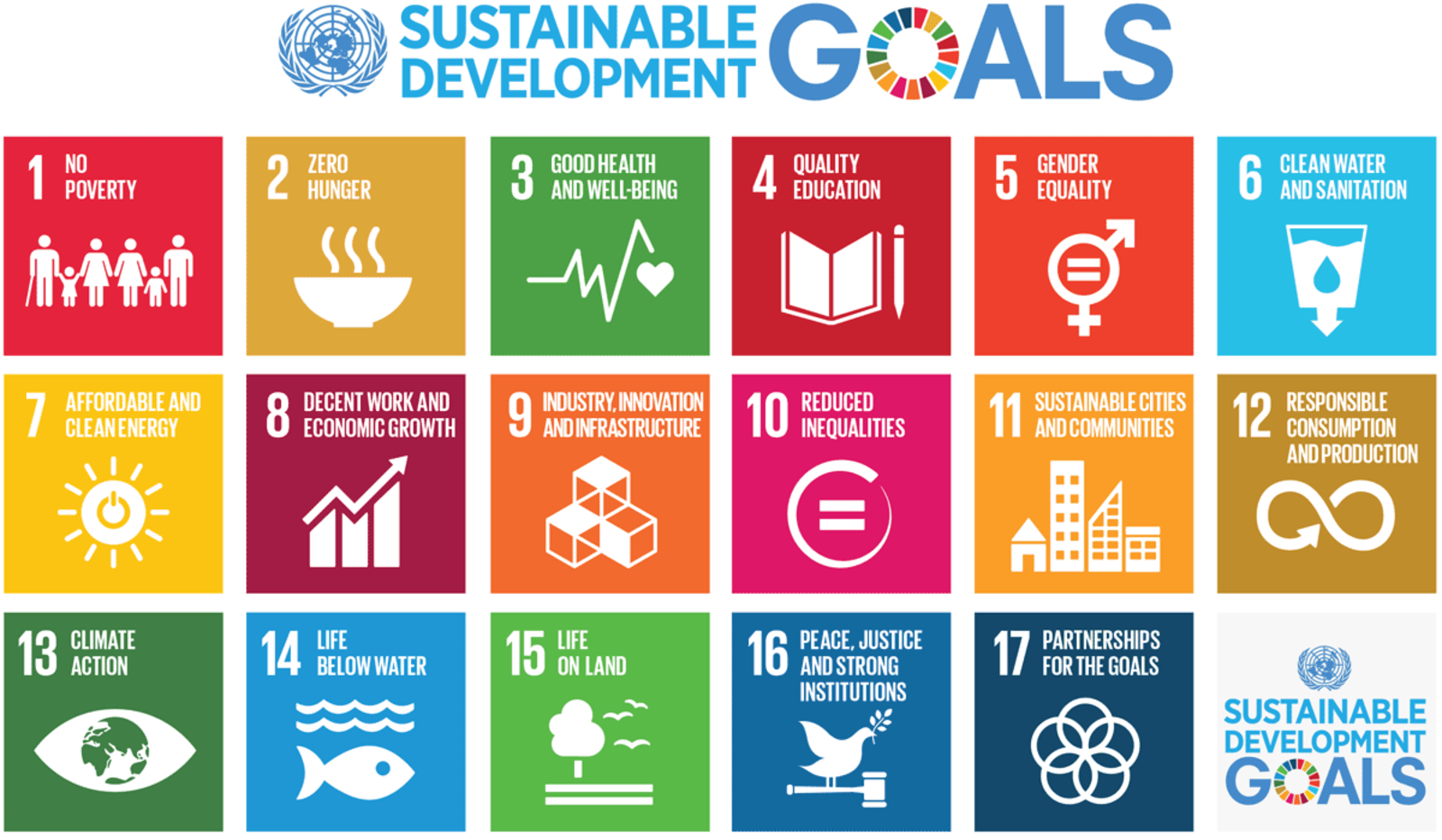
As above, while most of the urban households use LPG as the medium for cooking, most of the rural households cook on firewood which comes in largely from deforestation and spurs a carbon disaster. 5 of the 17 Sustainable Development Goals (SDGs) as follows are of particular relevance to clean cooking programs. Yet, the due corrective action in Nepal leaves much to be desired.
| SDG | Developement goal | Relevant targets |
|---|---|---|
| 3 | Health and well-being | Reduce under-5 deaths. Reduce illness and early death due to air pollution |
| 5 | Empowering women and girls | Improved access to enabling technologies |
| 7 | Access to reliable, efficient modern energy | Affordable, reliable modern energy |
| 13 | Combat climate change | Implement climate measures into national policies |
| 15 | Sustainably manage forests and halt land degradation | Reduced deforestation.Reduced land degradation and desertification |
Today on the World Environment Day, and the year earmarked for tree plantations, it may be worthwhile to invoke Felix Finkbeiner here, who at age 13 went on to deliver a rather passionate speech to the Heads of Governments at the UN General Assembly in 2011 wherein he bluntly told them that there was no action from governments on all that concerns the environment and implied that they were mute spectators to the peril confronting the planet. Felix leads a movement called "Plant-for-the-Planet" which looks at planting a billion trees the world over to fight the crisis we are all enduring. The following YouTube clip may be viewed to get into sync with the crisis we confront and the action needed right away. If Felix can do it at such a tender age, how can the world remain immune? https://www.youtube.com/watch?v=tGLtkbaeupI&feature=youtu.be We have to look at sequestering carbon dioxide with all possible efforts such as massive reforestation/afforestation drive on one hand, and on the other hand, we need to look at substituting fossil fuel use with renewable, green and clean energy sources wherever we can. Largely reducing use of fossil fuel and spurring a circular economy has become indispensable. It is pertinent to bring in the views here below of an acknowledged environment expert, Ajaya Dixit, with regard to the need for renewable and clean energy sources for household cooking. He is the Executive Director of Kathmandu based ISET-Nepal. His monthly column ‘Climate for Change’ deals with the impact of global warming in Nepal. Excerpts from Dixit’s article in Nepali Times, “No Smoke Without Fire”: https://www.nepalitimes.com/opinion/no-smoke-without-fire/
“Nepal needs to be careful about alternatives to biomass in the country’s next phase of economic development. Poor implementation of public policies has contributed to the inability to replace biomass and imported petroleum products with clean fuel sources like hydroelectricity, particularly for household cooking.
Efforts to replace biomass with cleaner energy sources must be reinvigorated – it can be a low hanging fruit in Nepal’s decarbonized economic development pathway. A more holistic energy policy is required, one that provides universal energy access, green jobs, improved health, gender and social equity, lowering the petroleum import bill and mitigating black carbon emission.
As a starting point, the Energy, Forest and Environment Ministries, WECS and the Alternate Energy Promotion Centre in consultation with the private sector and donor agencies must collectively establish a baseline of Nepal’s current energy use. They must also consider measuring sources of emissions according to international protocols so a low-carbon development strategy can be designed.
Elected rural and urban municipal, provincial and national governments, as well as community groups need to work together in linking biomass replacement efforts with the UN’s Sustainable Development Goals so that it resonates with scenarios outlined in IPCC’s latest Special Report 1.5.
Learning from the past, new strategies to replace biomass usage must consider the household’s geographic and social milieu, income, individual preferences, behavior, technology, availability and affordability of fuel types. This requires bringing together unique business and development models that can be sustained through funds with varying costs of capital such as public, pricing, overseas development assistance, multilateral loans, as well as philanthropic outlays.”
Dixit’s views are a manifestation of popular perspective of experts in this regard which calls for sustainable, renewable, green, clean and cost-efficient energy solutions for cooking.
So, what source of energy qualifies as the most optimum one for cooking in Nepal’s context which is sustainable, renewable, and greenand is also cost-efficient?
Hydroelectricity could have been a choice, but unfortunately, there is already a huge deficit in supply due to its larger need and the historical perspective on its harnessing being pathetic. Any new augmentation herein takes time and supply side is not very elastic. The backlog of demand on a larger application turf herein itself will take several years to get serviced considering the slow progress of plants in pipeline.
No less efficient an option considering diverse aspects discussed here above, is Biogas. In fact, many would contest that this is not just the ‘next best’ option – but, actually, the best, for a variety of reasons that even hydroelectricity cannot parallel.
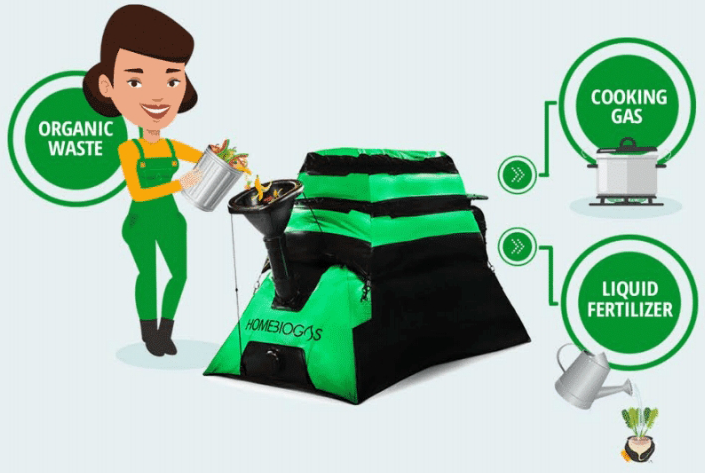
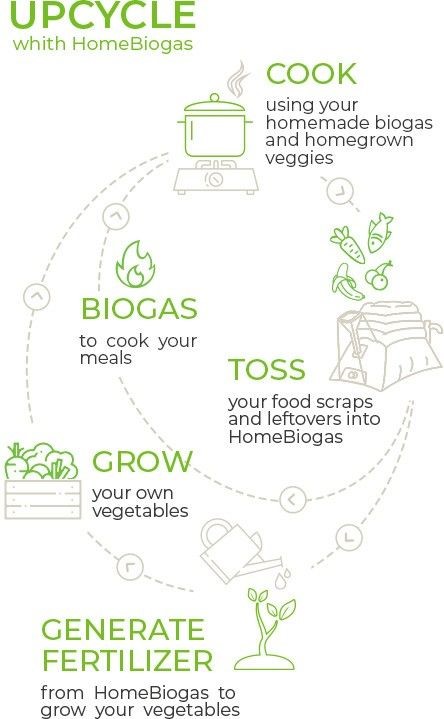
It is in fact a path to a circular economy. The visual ahead illustrates the life cycle it is. Imagine using kitchen waste to generate energy (biogas) and then cook your food with that very output, and in parallel, also produce a high quality organic fertilizer to grow your vegetables and more, and then again the same grown objects are cooked on the energy produced by yourself, and thereafter the leftover or call it the kitchen waste or residue, goes back again into generating energy, completing the cycle!!
Biogas is a sustainable, renewable, green energy solution and has a brilliant role in practices moving to a decarbonized society.
Getting energy from the fermentation of waste products such as kitchen waste, agricultural residues, manure, and sewage, biogas provides a route towards a circular economy in the use of products transcending their service life.
There is a plethora of advantages to an improved biogas system, from waste treatment, production of organic fertilizer, generation of renewable energy - thehealthy blue flame gas suitable for cooking, heating or lighting, and for improved water quality and provision of jobs in rural communities.
Since the technology used in the production of biogas is relatively low-cost, it is easily deployed in domestic settings. Small bio-digesters are good for use in the home, with methane sourced from kitchen waste and animal manure.
On a larger dispensation, the biogas facility takes the form of a bio-factory where value is created from previously wasted materials which ensures sustainability of the environment and potential for financial gain for the local community. The biogas plant is the hub in the future circular economy.
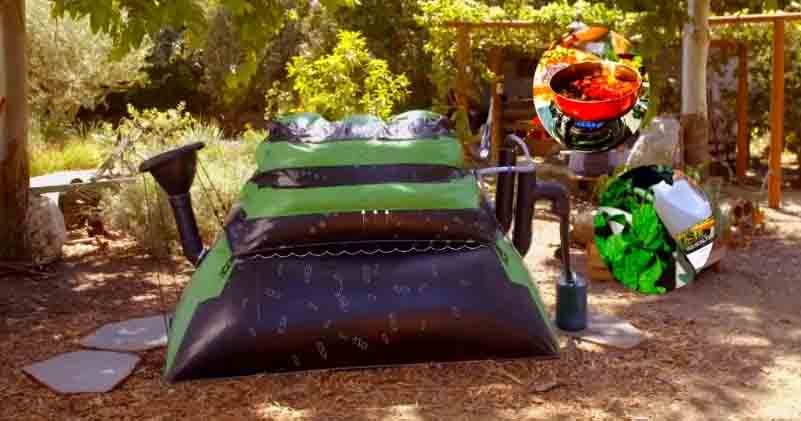
Biogas is an amazing energy source which has few parallels. All that is needed to be considered is that the technology used is an improved one which does away with the inherent handicaps of the erstwhile technology and provides an impeccable solution. It has now been rendered absolutely user-friendly and can also be moved from one place to another when needed. Among all renewable energy sources, this is one source which has a plethora of virtues – in fact, endless - some of which (not in isolation) are as follows:
It has been cited as a renewable energy alternative with great potential due to the fact that it is a zero-emissions process. By capturing methane emissions, biogas plants work to curb the greenhouse effect and limit the amount of harmful gases spread in the atmosphere.
By linking up and closing the loop on the previously linear processes of sending organic waste to landfill, anaerobic digestion is able to tackle waste, energy, sustainable food production and nutrient recycling challenges in a sustainable and circular manner.
In addition, biogas generation relies on renewable, natural materials that can be replanted or reproduced, thus making it a sustainable method.
The by-product of the biogas generation process is enriched organic digestate, which is a perfect supplement to, orsubstitute for, chemical fertilizers, which often have toxic and harmful effects. In contrast, the organic digestate can accelerate plant growth and resilience to diseases.
(AnIllustration)
Biogas plants have been successfully operating in Nepal with approximately 350,000 plants installed, maximum of which have been done under the BSP-SNV partnership for decades now. However, those are generally fixed units made of RCC, primarily in the rural areas and are operating on only animal manure. Urban areas could hitherto not avail this medium because the choice or option of input (animal manure) was cumbersome herein. Another problem that has been there in urban settings is, the amount of fixed space required for building up the RCC tank and dome etc. Land prices as we know are pretty steep in urban areas and people dwell in small land holdings. If we take Kathmandu as an example, even an average middle-class family lives in few annas of land and dedicating a fixed part therein to something which is inelastic, is obviously rendered difficult. Yet another handicap hitherto was the ever-spiraling costs in building an RCC biogas unit. Besides, if a family is living in a rented premise and has to shift residence at some point of time, the plant cannot be moved out – it has to be demolished and the salvage value is barely anything.
However, now with versatile and scientifically advanced, portable digester having been rendered available by Israel’s tech leader, HomeBiogas, which works universally on kitchen waste/agricultural residue as well as animal manure either separately, or, also as a mix, now largely broaden the application so as to cover the urban need as well as rural at the same time. As regard the biogas installations in rural areas too, the scope increases manifold now with user-friendly, cost-competitive, technologically-advanced, portable digesters.
While the nation has been ardently needing a sustainable, renewable, green and clean energy solution for the cooking, portfolio, inter alia, two visionary social entrepreneurs Ram Agrawal and Bipin Khetan, have always nursed a dream to bring an end to the risk of life borne by under-privileged women in Nepal who have been cooking on the huge carbon-emitting-source, i.e., firewood, resulting in more than 8000 lives lost each year, besides hundreds of thousands being subjected to illnesses as fatal as lung cancer, COPD, ALRI, IHD etc, many of whom sadly end up losing lives. They have been concerned as much about the huge menace of deforestation happening for the sake of firewood – resulting in natural disasters taking thousands of lives. Their envision to bring in sustainable, renewable, green and clean energy at affordable costs across the spectrum, and to work towards drastically reducing the fossil fuel footprint, assumes critical significance. Their concern towards upkeep of environmental sanctity transcends economic considerations. Towards this mission, they have tied up as the country distributors with a leading technology company in household biogas globally, HomeBiogas who have been working in partnership with the likes of United Nations, European Union, USAID, SNVinter alia and are launching the state-of-the-art units across Nepal, now to render it available much competitively in terms of functional efficiency and costs, both, as compared to what was incurred on the prevalent RCC model. The duo has interests across various arenas including real estate development, FMCG, automotive tyres, dairy products, pharmaceuticals, commodities inter alia, but their passion lies in social emancipation and empowerment of their fellow citizens. Their foray into this arena bears out of their philanthropic concern and a persistent research for years on solutions, which, with intervention of technology will help save poor lives and shall also help sequester a large amount of Co2 towards an improved ecosystem in a nation that has been highly vulnerable against earthquakes, inter alia – a dastardly calamity that has needed strong initiatives that could neutralize the disadvantaged poise here in the environment caused by factors such as massive deforestation and large amount of emission of Co2 in use of fossil fuel. Each HomeBiogas unit of 2 cbm helps sequester 6 Tons of Co2 in a year. In tune with their lofty vision Ram and Bipin, look forward to sequestering tens of thousands of tons of Co2 every year. By putting forth a paradigm as this, they are sure to beckon many environment-friendly initiatives in the arena ofrenewable, sustainable, green and clean energy that shall strengthen the ecosystem and help reduce the risk of disasters. Their vision encompasses the entire gamut of renewable energy in the arena of hydro, solar, wind and bio-energy with more specific emphasis on the gamut of Biomass, Biofuel, Biogas, Biotech and Bio-engineering with a mind to go on a backward integration emanating from tree plantations – a pledge taken to revolutionize measures of correction for the ecosystem taken today, the 5th of June, when the world commemorates the World environment Day. Since Nepal is endowed with large untapped potentials in biomass and biofuel production, they are looking at a possible foray into the cycle of biomass, biofuel, biogas et al. In pursuit of their vision, they look forward to working with multilateral and development agencies towards a shared mission in addressing the issues as enumerated in the Sustainable Development Goals. This is one initiative in their larger vision of working on the broad gamut of renewable energy and beckoning energy security through harnessing potentials in this arena. Processing of the abundant available resource of Biomass for Biogas, inter alia, in the manufacturing arena in the future shall help them realize their mission to take it to the next level beyond the household cooking arena – i.e., to substitute fossil fuel consumption in a good measure in the areas of transport, industrial boilers and more. This shall generate large amount of green jobs and provide a much-needed fillip to the circular economy.
Global Renewable Energy Giant Engie, too, finds merit to invest in HomeBiogas.
https://www.youtube.com/watch?v=x_L6ROQbSw8
https://www.youtube.com/watch?v=Yup6aCSp_VU
https://www.youtube.com/watch?v=XnRsRKY0Beo
https://www.youtube.com/watch?v=xuq_SSmklrA
https://www.youtube.com/watch?v=sfbda0D3C9E&feature=youtu.be
Stringiest Quality Standard Certifications:
A 2 cbm portable plant of HomeBiogas is rendered available at only Rs 59000 as against a similar sized RCC plant costing around Rs 82000 in Kathmandu, makes it facile for users hereon. The 6 cbm plant shall be launched by around July/August 2019. The Pay-Back of a 2 cbm HomeBiogas unit is understood to be tentatively as follows: (Basis: ‘Per Year’)
This works out as Rs 38800 on conservative numbers of realization value. Add to the price of a HomeBiogas unit an approximate interest cost of Rs 10000/annum on microfinance, the pay back is approximately 2 years. On a conservative count, we can say 2 to 3 years.
However, for restaurants and other kinds of eating places like canteens, community kitchens etc where kitchen waste quantum is higher, the payback is much faster as the amount of organic fertilizer available each day is 6 Liters against a maximum input of 6 kgs of kitchen waste. The economics thus will be 6x25=150x30=4500x12=54000.
We have taken an average of 3 different possibilities in terms of number of hours operated by the end-user – I.e., 2 hours, 90 minutes and 1 hour in which of the varied cases the output from HomeBiogas shall be 8.8 kwh, 6.6 kwh and 4.4 kwh, respectively.
Thevalue of Biogas as per para 1 above and that of solid paste as per para 3 above remain the same at Rs 10800 and 10000, respectively. Add to these Rs 54000 and the sum is 74800.
In this case the payback period is only 1 year as the cost i.e., Rs 59000 + Rs 10000 for interest make the costs add up to Rs 69000 against a revenue of 74800.
Again, on a conservative count, we may peg the payback at 12 to 18 months.
The payback of HomeBiogas 6.0 shall be even better. We are working on it and the details shall be available in due course. For those needing more no of hours of cooking and for more fertilizer output backed by higher feed-input, the 6.0 option is colossally more advantageous. Even the cost comparison between HBG 6.0 and an RCC structured unit will be more than the 25-30% difference in case of 2 cbm unit.
With all the virtues that emanate from Biogas, one wonders why all concerned government and development agencies should not promote this as a spontaneous choice in national interest. Let there be a debate on this if there still lies an ambivalence on its mass implementation.
All that is needed is a reinforced initiative to promote this in tune with the evinced focus at the end of AEPC, all the concerned Nepal government departments, the municipal corporations for waste management, the financial institutions with special emphasis from the designated FIs and Micro Finance Institutions who avail resources at very low interest rates facilitated by AEPC for onward transmission. Corrections are needed forthwith on this count and due evaluation from concerned agencies need to be made on an expeditious measure. The multilateral and development agencies like the World Bank, ADB, UNDP, SNV, DANIDA, DFID, USAID, GIZ, KFW, GTZ, UNCDF, inter alia have been very keen to support the program but they probably could be provided more of information on such an available solution which solves the need in a win-win dispensation by promoting this novel energy source.In fact,while these agencies are known to be actively engaged in supporting sustainable and renewable energy sources, they may like to check if this is being done, and if not they may like to take appropriate measures towards this. Waste Management itself is such an issue for all municipal bodies which gets largely addressed with this. Maximum portion of the waste generated in households being organic material, there is a god-sent spontaneous solution herein. But, we must accord due cognizance to it and harness it in the best possible measure. In fact, considering the poise, there needs to be a strong initiative at their end. Besides, there are more than 200INGOs and overseas development agencies in Nepal for whom too promoting Biogas should be a priority envision considering its critical importance as also underscored by the SDGs. In fact, we encourage the esteemed institutions to support the needy with systems readily available. We hope to see renewed action on Biogas promotion as a sustainable, renewable and a greensubstitute for LPG and firewood. LPG is imported to the tune of over 370,000 MT/annum incurring a bill of over Rs. 35 billion for the exchequer. Besides being a fossil fuel, LPG is also vulnerable from the point of view that the supplies are subject to difficulties at times against which the end-user has no option of immediate substitution/replenishment. This is a critical situation as LPG is meant for cooking food and its abrupt absence brings in utter chaos among households. Similarly, an early replacement of firewood as the unfortunate cooking medium in rural areas which spurs deforestation and a huge environmental catastrophe is necessary.
Since Biogas unarguably works as the most sustainable, renewable, green and economical option, it is expected that the government departments and the multilateral and development agencies make good the lost initiative by whole-heartedly supporting the promotion. It is important for them to take cognizance of the fact that the end-users must be provided credit on a facile basis – they should not have to go through red-tapism or kind of bureaucratic hassles to own a biogas unit. It is understood that AEPC provides funds to MFIs and other institutions at subsidized rates of interest for onward funding to end-users, but in practice, this does not appear very facile at the end of the MFIs. When the daily operational cost on a biogas unit is nil, and instead when it provides value in form of organic fertilizer/slurry as well, besides providing sustainable, renewable and green energy (biogas), there should be no problem for the concerned departments and agencies to ease it with fund facilitation – instead there needs to be a sense of enthusiasm towards promoting biogas, which is somehow not evident.
The Subsidy policy also should be reviewed and more encouragement needs to be provided so as to truly revolutionize promotion of such a win-win solution, which is good for all: the end-user, the ecosystem, the economy, the society, the nation and all stake holders.
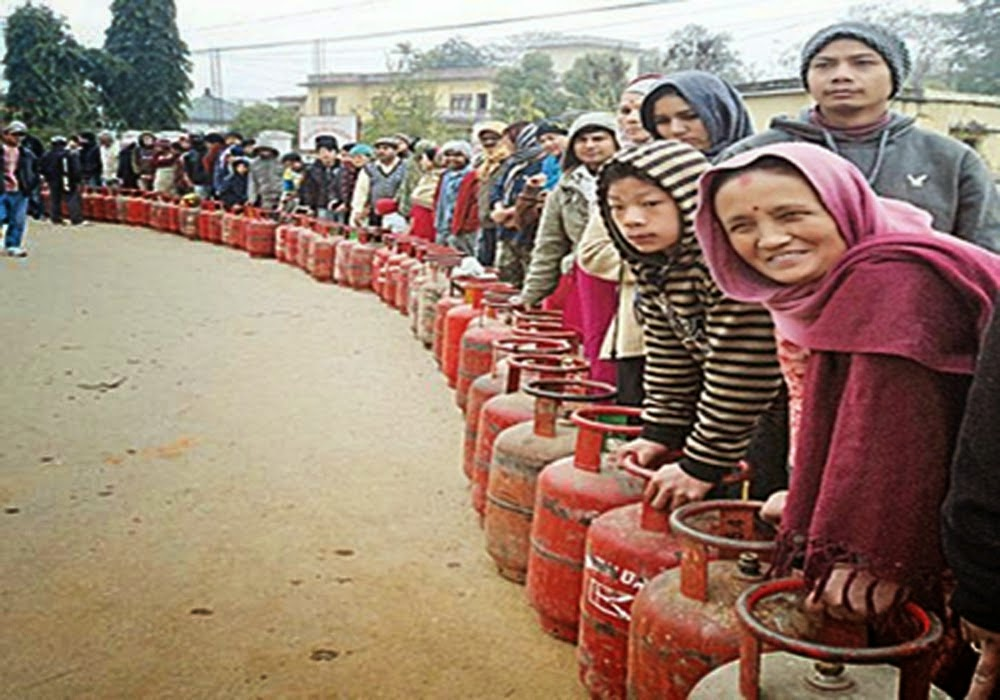
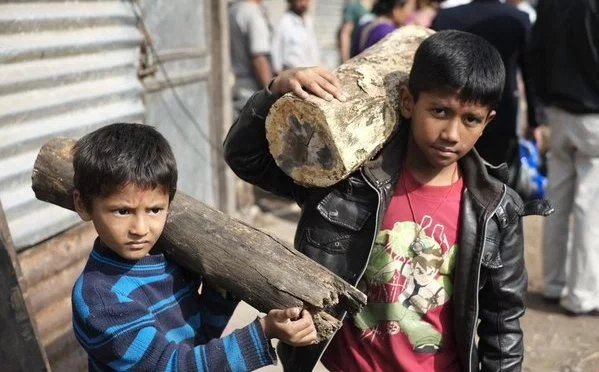
Here below, 2 photographs vividly narrate the vulnerability - one of an endless queue made by helpless people in a remote hope of a supply of LPG in times of crisis, and the other, of a very partial meeting of the need in the form of a substitute by the Government, in the form of "Firewood" which comes in as a result of deforestation, and is again not a desirable cooking medium - that gives birth to "Household Air Pollution" - a curse that takes lives of 4.3 million women the world over, and more than 8000 lives in Nepal, annually as mentioned here above.
| Comparison Chart | Bio Gas | LPG |
|---|---|---|
| CONSTITUENTS | METHANE | PROPANE AND BUTANE |
| Can it be produced by common man at home | Yes very easy to set up and maintain | No. Need sanctions, permissions, huge capital, drilling, laying of kilometers of pipelines etc. |
| Cost | Very cheap…. Cheaper than water | Expensive |
| Energy density | Danger of catching fire almost insignificant | 94 MJ/m3 more than double the CNG energy. thus highly inflammable |
| Source | Can be easily created even by kids for experiments. In fact any decaying matter creates biogas in absence of oxygen. | Automatically generated from gas fields when natural gas is extracted from the reservoir. By- product of cracking process during crude oil refining |
| Uses |
|
Can be used for the same purpose as CNG but it is dangerous due to its higher energy density. Thus it is illegal to use in automobiles. On the other hand CNG is approved for use as fuel in automobiles. |
| Environmental effects | Releases lesser greenhouse gas. | Releases CO2 which is a greenhouse gas but cleaner when compared to gasoline. |
| Properties | It is higher than air and hence disperses quickly in the event of spillage. | Highly inflammable. It is heavier than air and on leakage will settle to ground and accumulate in low lying areas. |
| Safety | Easily disperses, hence risk of ignition is minimized. | Since it is difficult to disperse risk of fire is more. |
A comparison of biogas with firewood may not be required as the jury is already out on the latter’s huge perils (on its use as well as the repercussions caused by deforestation) and the need to absolutely bring an end to its use.